It can only propose
Nothing changes on the board until a person clicks Approve. Not a setting, not a preference somebody can switch off in a hurry. The tool has no way to move your work on its own.
Most Design Ops is a service desk: a queue, a calendar, a tool inventory. Your posting asks for the other thing, the function that makes a design org faster the bigger it gets. I have built that function from nothing once and hired the team into it. I am the operating layer of a brand function now. And when the process needed a tool that did not exist, I built that too, with AI, and it runs every week.
Diligent on the financial, creative and timing dimensions, a go-getter, with strong UX and design input.
Owned creative, content, deployment and localization on android.com, with meticulous capacity planning to hit targets across all workstreams without burnout. Exceptional communication and problem solving.
A year-long program at Arizona Public Service, complex and multi-part, with both project and client management. A team player and problem solver who built strong client relationships.
13+ years in program and creative operations. New York based. An independent page, not affiliated with Mercury.
01 · Point of view
The same hour keeps going wrong. The resourcing meeting happens, real decisions get made out loud, and then somebody has to remember them and write them up afterwards. Usually late, usually thinner than what was actually said. The board drifts quietly out of date until the next meeting rediscovers it.
I built Vizor for myself, to manage my own team's capacity. The point of it is one sentence: the meeting should update the board, instead of somebody updating the board about the meeting.
Building it forced four decisions I would not have thought about from the outside, and those decisions are the actual point of view I would bring to this role.
Five steps, and the fourth one is a person. Nobody's week gets rearranged before somebody has looked at the change and said yes.
I care about this more than about which model anyone picks. A policy is a promise. Building the promise into the thing means nobody has to remember it on a bad Friday.
Nothing changes on the board until a person clicks Approve. Not a setting, not a preference somebody can switch off in a hurry. The tool has no way to move your work on its own.
A suggestion with no source is one you either swallow or ignore, and both are bad. Carrying the exact sentence back means a proposal is something you can argue with rather than something you have to trust.
The speech becomes text on the laptop, and only the text goes anywhere. You are asking a team to let software sit in on the hour where workload and staffing get discussed. That is the most sensitive hour in their week.
Encrypted, revocable, and they see their own bill. Without a key the AI features simply switch off and the capacity planning still works. Nobody is locked in by the clever part.
None of this is about AI being dangerous. It is about the resourcing meeting being the most politically loaded hour in a design team's week. Move somebody's work without them watching it happen and you do not get invited to a second meeting. Worth knowing: when Mercury shipped Command in June it landed on the same instinct, staging every action for a person to confirm. Different field, much higher stakes, same answer.
02 · The intake problem
Every quarter, six teams at Dow Jones send in their plans and requests. Subscription strategy, product design, product management, performance marketing, CRM, event marketing. Each sends its own spreadsheet, in its own shape, half of it written in a hurry.
I started six months ago, so that has landed on my desk once. Once was enough. Asking everyone for a single template has never worked anywhere I have tried it, so I built Relay to take the files exactly as they arrive. The teams never open it.3
Click through the six steps. Watch the request on the right fill itself in, including the moment it admits it does not know something.
Nobody is doing anything wrong. Six teams have six ways of describing work, because they do six different jobs. The fix is not a nicer form. It is a thing that reads all six.
Six teams, thousands of cells. The volume is why this is a system and not an afternoon.
They arrive as sentences in a cell. This is the one step where the AI genuinely earns its seat, because no formula gets you from that sentence to a resourced line item.
"Q3 paywall test, need design + copy, maybe eng? mid Aug, check with Sarah"
Everything on the right is pulled out of a cell like that one. Nothing is re-typed by hand.
Three teams describe the same week three ways and the same page three ways. A plan built on six vocabularies is six plans, so everything downstream depends on settling on one.
The third row is the interesting one. It does not guess. It flags the hole and moves to step four.
This is the step I care most about. A tool that hands you a list of gaps has moved the work, not removed it. Relay writes the follow-up, sends it, holds the request open, and fills the hole when the answer comes back.
"Quick one on the Q3 paywall test: who is the owner on your side? Everything else is in."
Nobody was chased by hand, and the hole from step three closes itself.
Every item carries a reason and a capacity cost, so the order is arguable rather than handed down. Anything low confidence or over capacity does not get quietly sorted. It lands in a tray that needs a person.
Where the human stays. Relay does the reading and the arithmetic. Priority is a judgment call and stays one.
Planning finishes in Relay. Only then does the finished plan move into Asana, where the PMs run execution and everyone sees their tasks. I own that Asana setup too, which is why the fields line up on both sides.
plan, capacity, sequence
tasks, owners, status
Plan in Relay. Execute in Asana. Never distort the plan to fit the tracker.
03 · What I built
Same three questions for each one, because the transferable thing is the method rather than the subject. The middle question is the one nobody can answer without having built the thing.
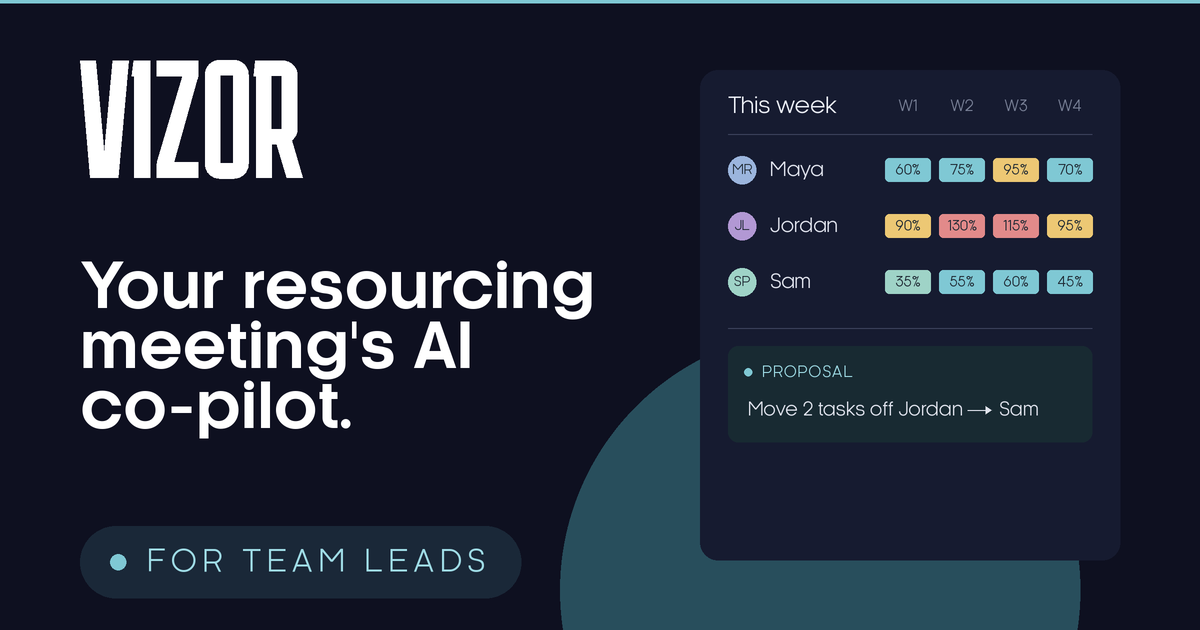

1 / 3
04 · The fleet
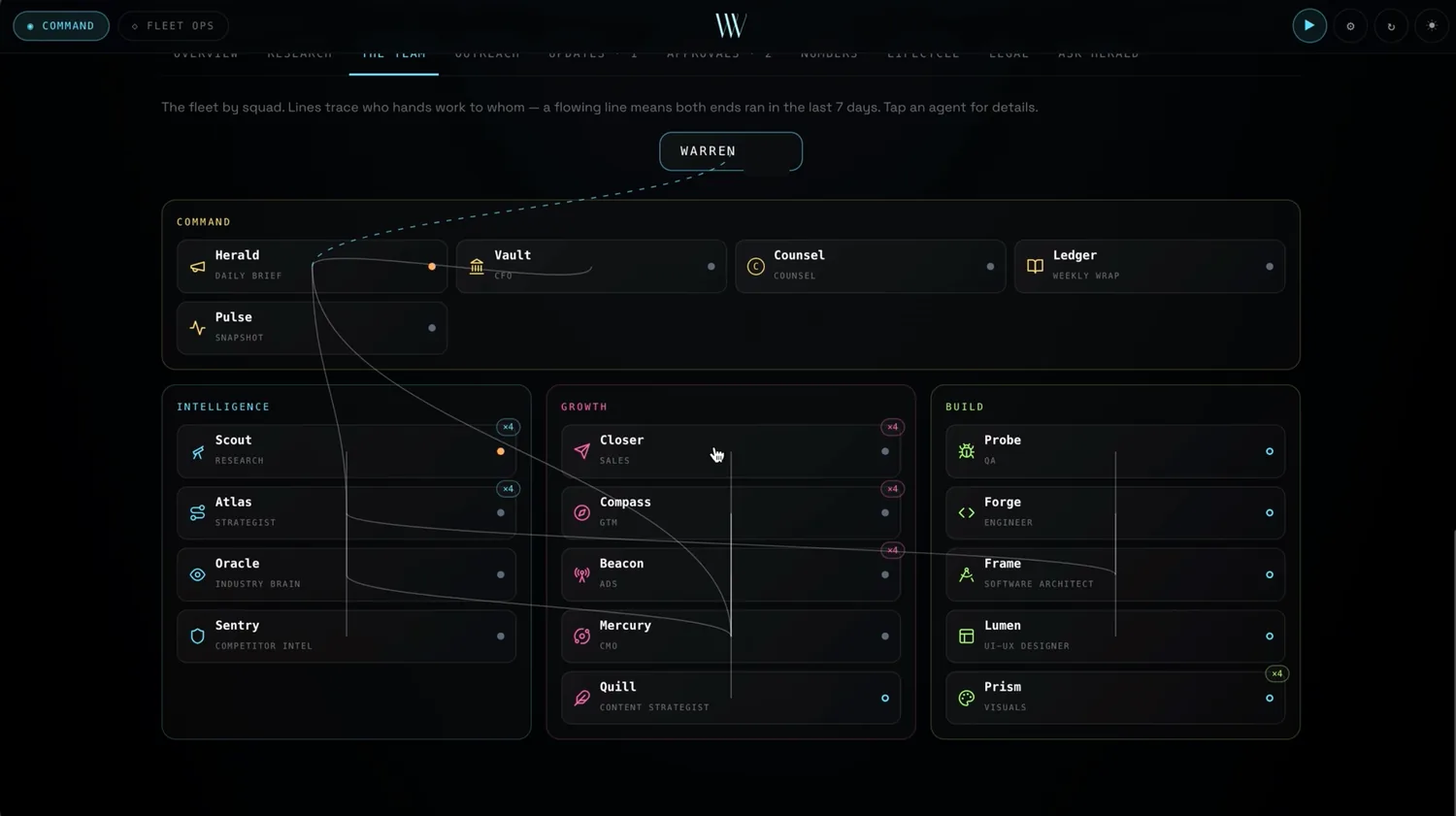
Nobody asked for this and nothing depends on it commercially. I built it on my own time, with my own work as the test case, because I wanted to know how far the idea actually goes. It is the most complete thing I can show you about how I take a problem apart.5
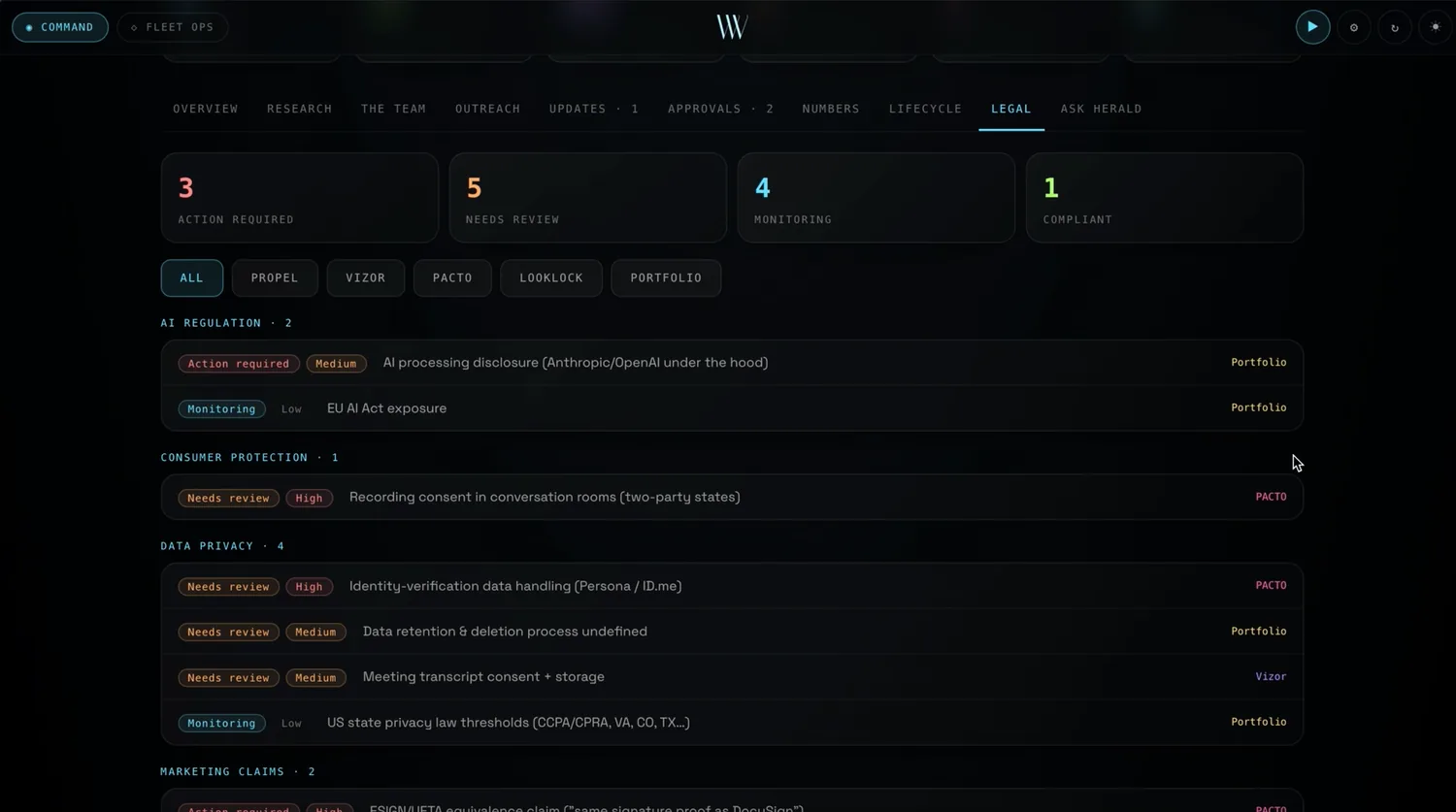
The same system's compliance view. Every open item sorted by risk and by product, across AI regulation, consumer protection, data privacy and marketing claims. Read the counts: mostly open, one cleared.
That is what a working tracker looks like in month one, and publishing it that way is the point. A screenshot with everything green would tell you nothing about whether it runs.
What matters operationally is that each agent runs on its own schedule, the hand-offs are traced, and the cost is tracked per agent. The work has a unit price and not just an output, so "is this automation worth keeping" has an answer instead of an opinion.
05 · The thesis
The posting asks for someone who defines the thesis rather than executing a list. So here is mine, built from what a careful reader can learn from your published work. Some of what I propose below will be wrong, because I have not seen the inside. Being told which parts, and why, is the fastest way I know to find out what I am missing.
Your design tokens are readable in your own shipped stylesheet: a base palette feeding named, purpose-based tokens, each with its own hover, pressed, disabled and inverted state. The inverted set is why the marketing site can run dark while the product runs light off one source. That is careful work, and it has designers and engineers dedicated to it.
The Design Ops question is not whether the system is good. It is whether a designer in week one can find it, know which token to reach for, and know who decides when the answer is not in there. Design Ops does not own the system. It owns the distance between the system and the person who needs it right now.
The failure mode of design metrics is measuring output, which makes designers defensive and tells leadership almost nothing. In a growing design org the thing worth measuring is rarely how fast a designer works. It is how long work waits.
This is not a theory I read. It is what I built into Vizor: moving work into review frees the assignee's capacity and starts a clock against that reviewer's own typical turnaround. Each reviewer is measured against themselves, not one org-wide number, because a legal review and a copy review are not the same promise. The measure implicates the system, not the person. That is the kind a design team will let you keep.
The posting pairs owning the AI point of view with partnering with Procurement, and those belong together. Procurement is a gate, and gates are worth being good at, but it is not the bottleneck. Designers do not change how they work because a tool got approved. They change because two or three genuinely painful parts of their week got rebuilt with them, and the new version is obviously better.
What makes this useful to a Procurement partner is not the framework. It is that it produces a written sentence explaining why the alternative was rejected, which is the thing they need and rarely get.
And what I would deliberately not do
No capitalized methodology, no acronym, no rollout deck. In a design team this size, a named framework is a tax the team pays so Design Ops can be legible to people outside it. The team should be able to describe how work moves in plain sentences.
No velocity per designer, no tickets closed, no output counts. Not privately, not "just for capacity." The moment a designer believes a number about them is being watched, the number becomes the work. If leadership needs an answer to "are we under-resourced," the honest one is wait time by stage, coverage against what we committed to, and a count of what we declined.
Every ops person's instinct on arrival is to fix the front door, because the front door is where the pain is visible. It is also the thing most likely to be holding something up in ways a new person cannot see. Read the queue for six weeks first, then touch it.
There are already people whose job that is. Design Ops taking ownership of the system would be a land grab dressed as helpfulness. My job is adoption, documentation, the decision path when the system has no answer, and making sure the people who own it get the credit.
At Everyrealm I hired the team and introduced the production processes and ceremonies they worked inside, then cut the ones that stopped earning their slot. Adding process is the easy half and it is the half that looks like the job. Removing it is where the judgment is, and it is why rebuilding intake sits on the not-yet list.
06 · The posting, audited
Sixteen lines from the job description. Nine I can prove outright, seven are partial. Open any line to see what I can point at, and every partial says exactly where the gap is. The partials are the reason to read the rest.
What the role owns
Section five of this page is that thesis, with four named subtractions. Everyrealm supports it: I decided what a creative operations function would and would not cover, then staffed it. Marked partial because writing a thesis is an artifact, not a track record of having run one through execution inside a design org.1
Relay, Vizor and PACTO, built solo directing AI, plus a nineteen-agent fleet in four squads with traced hand-offs and cost tracked per agent. A stated buy, adapt or build framework I have actually used.3
Vendor and partner management at Everyrealm and through Infosys on Arizona Public Service, plus agency-side work at Moving Brands and Prophet, so I have been on the selling end of the contract. My stated strength is profitability through resource utilization and capacity management.7
At Dow Jones, one design system replacing eight property-specific build processes, six of eight migrated, build time cut about 80%. At Vertic, a comprehensive design system for Arizona Public Service after a three-month research phase and an eight-month design phase, with Infosys and 28+ engineers.
At Everyrealm I introduced production ceremonies into a team I had just hired, and cut the ones that stopped earning their slot. At Google I kept three web properties on one launch calendar across time zones.9
Section eight is a researched read of Mercury's current external design presence and a concrete plan. Direct experience: android.com including the Android 12 launch, and the event and conference properties at Dow Jones, including JournalHouse and the WSJ Leadership Institute.6
At Everyrealm I sourced, hired and onboarded 3D artists, UI and UX designers, motion and visual designers into a function that did not exist before I arrived, and wrote the methodology they ramped into. The hiring bar and the onboarding bar were the same decision.
I am currently the bridge: brand steward for all product touchpoints and product-connected materials, fielding quarterly plans and requests from six functions, resourcing my team across design, content design and copy. At Everyrealm I worked across finance, architecture, product, marketing and web3 engineering with no playbook.10
A year-long, deliberately ambiguous exploration for Google Search Ads, run in partnership with Google's Search UX Design Director and his team. At Arizona Public Service, bringing skeptical utility executives into the process rather than around it.11
At GE Healthcare, the executive-level visualizations that kept a global campaign's leadership aligned while volume flowed underneath. At Dow Jones I own the Asana setup for reporting, capacity and resource management. Vizor is a committed position on what to measure: the wait, not the worker.
What the ideal candidate has
Everyrealm: a horizontal creative operations function, defined and staffed from zero, spanning finance, architecture, product, marketing and engineering. I wrote the thesis and nobody handed me a list.
Two years in Google's Android pod from Huge, leading a team of four to six designers on Huge's side and holding a peer relationship with Google's Search UX Design Director, with no authority of any kind. Four references on record, from a director, a Design Ops practitioner, an IC designer and an executive director.
At Prophet, an MVP redesign shipped for a pharmaceutical client during the Endo–Mallinckrodt merger, where waiting for consensus was not on the menu.
Everyrealm from zero. Relay built rather than bought. Vizor and PACTO shipped solo. I do not have a maintenance résumé.
Hulya G., Director of Web Marketing Strategy at Google, on the record about meticulous capacity planning across all workstreams without burnout. Gary Goldsmith, Design Operations at Meta, on the record about the quality of my program work.
Vizor's review clock exists because I watched projects slip on stakeholder feedback and wanted the slip visible before it became a miss. At Google, an immovable public launch date on Android 12.
07 · Adoption
This number is usually reported as an outcome: eight website properties unified into one, six of eight migrated, build time cut about 80%. Reported that way it sounds like an engineering result.
It was not. Consolidating eight property-specific builds meant getting agreement from the people who already owned those builds, and that half of it was not engineering.8
Two of the eight are not migrated yet. Six of eight is the honest state of it, and it is the number I would rather report than a rounded one.
I put this here because it is the fair challenge to everything in section three. Relay has one user and Vizor is a private beta, so if you want evidence that I can get other people to change how they work rather than build something they might, this is the piece of the record that carries it.
Eight event properties across WSJ.com, Barron's.com and MarketWatch.com. Unnumbered rather than named, because which ones migrated first is not mine to publish.
08 · External presence
One of the responsibilities in the posting is owning how Mercury Design shows up externally, from content to events to award submissions. So I looked. What follows is what a search found. It is not a judgment about the team.
"Did not find" is a statement about a search, not about the team. See footnote six.
A design team this size, with a token architecture that careful, a physical culture book and a commissioned editorial property, has more publishable material than most design teams that publish constantly. From the outside I could not tell who owns the pipeline that turns that material into published work. Your posting asks someone to own it, which suggests it is a job worth doing, so here is how I would start.
The token architecture is the obvious first piece, written with the designer who built it and bylined by them, not by Design Ops. My job is the deadline, the editor and the publish button.
Awwwards, Webby, Fast Company Innovation by Design and Communication Arts all have fixed deadlines and long lead times. A calendar with named owners, plus a habit of capturing process while the work is still warm, is most of the job. The craft is not the constraint here. The submission never getting written is.
External presence is in this posting because a design team that keeps growing needs candidates who already know what the work looks like before they apply. So measure it there: source of applicant, quality of pipeline, time to fill. Not impressions.
09 · Selected work
Thirteen-plus years of the same work under names that kept changing, because the function did not have a settled one.

Roadmap, creative, content, deployment and localization across android.com, tv.google and wearos.google.com, against a public date that could not move. Separately, a year-long research and design phase for the future of Google Search Ads, leading four to six designers on Huge's side with Google's Search UX Design Director and his team.

A Web3 metaverse start-up that initially received $50M+ from A16z and others, later pivoting to game publishing. I sourced and built the team of 3D artists, UI and UX designers, motion and visual designers, defined the project plans, and introduced the production processes and methodologies. The function did not exist before I arrived. This is the closest thing in my record to a team of one setting direction and then doing the work.

A new transactional .com and mobile app for Arizona Public Service, built on a comprehensive design system, after a three-month research and strategy phase and an eight-month design phase, delivered with Infosys and a team of 28+ engineers. I structured the review cadence so misalignment surfaced before build rather than during it.

The asset-production phase of the global Better Health Study, one of the company's largest marketing campaigns: executive-level visualizations, a global website, hundreds of media assets, and the supporting data analysis. The reporting is the part that transfers. Keeping leadership aligned on a cadence while the volume flows underneath is the same job as making a design function legible.

A members-only metaverse of one-of-a-kind 3D architectural landmarks by renowned artists. I owned the vendor relationship through implementation and platform testing to a single coordinated launch, plus external motion, 3D rendering and video production. Vendor management is Procurement's other half, and it is where I have most of my experience.
10 · On record
All four in full, including the two that rotate at the top of this page. A Design Ops practitioner, a director, an IC designer and an executive director. Four altitudes, on purpose.
Diligent on the financial, creative and timing dimensions, a go-getter, with strong UX and design input.
Owned creative, content, deployment and localization on android.com, with meticulous capacity planning to hit targets across all workstreams without burnout. Exceptional communication and problem solving.
A year-long program at Arizona Public Service, complex and multi-part, with both project and client management. A team player and problem solver who built strong client relationships.
Exemplary program management on a complex, large-scale project. Diligent planning, adaptability, and expectation management both internally and externally. His role was critical to its success.
11 · Roadmap
Design Ops is a team of one, so none of this is delegated. Each step names the thing that exists at the end of it.
Every path work takes into design: where it enters, who bypasses the front door, and why they are right to.
Output: a map of how work actually arrives, including the routes nobody documented.
Where does work wait, and on whom. Not to assign blame, to find out whether the waits are one reviewer, one stage, or one week of every month.
Output: a first, unflattering picture of wait time by stage, shared with design managers before anyone else sees it.
Both are inventories of what the org has already said yes to. Neither gets read as an inventory until someone does it on purpose.
Output: a kill-or-merge list for rituals, and an honest read on spend, overlap and real adoption before renewal season decides for us.
Written, observable principles, so priority becomes a lookup rather than a negotiation and the loudest requester stops winning by default.
Output: one page, in the open, that anyone can check my decisions against.
Two genuinely painful recurring parts of the week, rebuilt with the designers who own them, with a measured before and after. Not an org-wide rollout nobody asked for. This one runs through security review and procurement, so week ten is the target and not the promise.
Output: a working thing two designers use every week, and a number.
One leadership view, one short changelog, one adoption number per surface. Each owned by someone other than me.
Output: a reporting cadence that survives my calendar, plus the first written case for what Design Ops should invest in next.
All three look like leadership. All three spend the trust you need to make the boring changes that work.

12 · The ask
Producer, project manager, creative operations lead, program manager. This is the first posting I have read that asks for all of it at once, including the part I built on nights and weekends.
pr.wvelazquez@gmail.com · 917-554-5173 · New York · LinkedIn · PACTO
Disclaimers and footnotes
Mercury footnotes its own headline, which makes it a company that has built qualifying its own claims into the brand. So this page does the same with mine. These are not fine print. They are the part I would want read first.